



Ethereum has processed an extraordinary $25.8 trillion in stablecoin transfers during the first ten months of 2026, highlighting the blockchain’s expanding role in global digital finance. The milestone arrives as major financial institutions continue exploring Ethereum-based products, including JPMorgan’s tokenized money market fund.
Yet ETH’s market performance has not reflected the same enthusiasm.
That disconnect raises an important question: Is Wall Street overlooking Ethereum’s growing financial infrastructure while focusing too heavily on short-term price movements?
Ethereum’s $25.8 Trillion Milestone Reveals Growing Demand
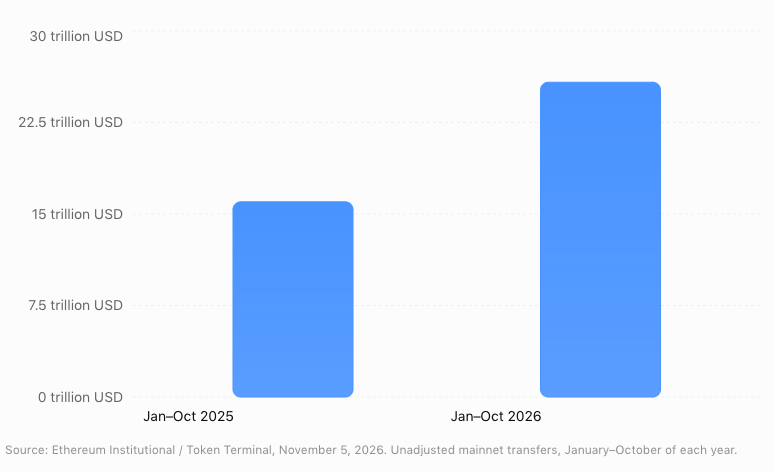
According to Ethereum Institutional’s State of the Ledger report, published November 5, stablecoin transfers on Ethereum mainnet reached $25.8 trillion between January and October 2026.
That represents a 61% increase from approximately $16 trillion during the corresponding period in 2025.
The number of stablecoin transfers also climbed 2.5 times to approximately 463 million, suggesting that network activity expanded beyond increases in transaction values alone.
However, the figures include all recorded transfers, including internal movements and automated transactions. They should not be interpreted as $25.8 trillion in retail payments or institutional settlements.
Even with that distinction, the growth demonstrates Ethereum’s importance as infrastructure for moving digital dollars.
The findings also reveal a significant improvement in transaction efficiency.
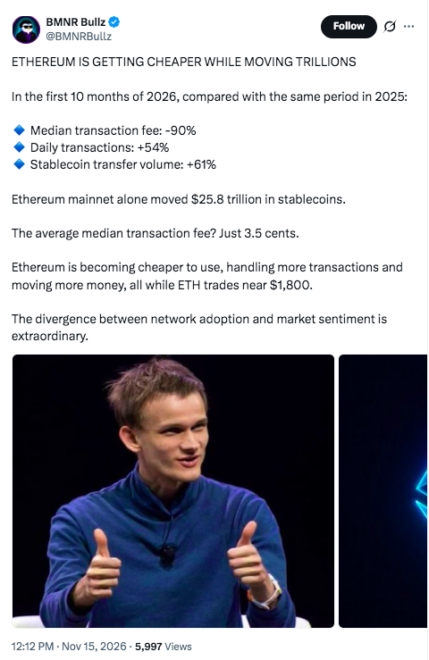
Ethereum mainnet averaged approximately 2.17 million daily transactions during the period, an increase of 54% year over year.
Meanwhile, average daily median transaction fees declined from approximately $0.35 to just $0.035.
The network is handling more activity while becoming considerably cheaper to use.
Why Wall Street Is Paying Attention
Ethereum’s expanding stablecoin activity comes alongside growing interest in tokenized financial products.
BlackRock CEO Larry Fink previously highlighted the potential advantages of blockchain-based financial infrastructure, prompting discussion about Ethereum’s role in tokenization.
The institutional argument is increasingly about practical infrastructure rather than cryptocurrency speculation.
Banks and asset managers are exploring how blockchains can support fund issuance, asset transfers, and digital settlement systems.
Ethereum already provides an established ecosystem of stablecoins, decentralized financial applications, and tokenized assets.
That combination could make it attractive to institutions seeking access to existing liquidity and blockchain-based financial services.
Nevertheless, institutional adoption does not automatically translate into higher ETH prices. Some applications generate substantial activity without producing equivalent demand for the native token.
Ethereum’s Growing Network Security Adds Another Dimension
Stablecoin activity is not the only metric showing expansion.
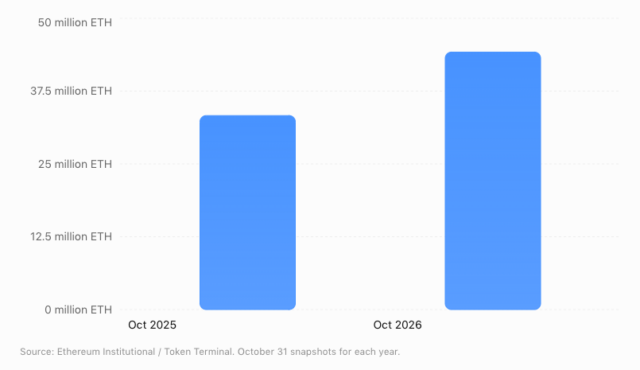
Ethereum Institutional reported that the amount of ETH staked increased from 33.3 million in October 2025 to 44.2 million by October 31, 2026.
That represents approximately 36.1% of circulating supply, compared with 27.6% one year earlier.
This development adds another dimension to the investment discussion.
Staked ETH helps secure the network while reducing the quantity immediately available for trading, although withdrawals remain possible.
Institutional participation in staking has also attracted attention, with Grayscale expanding its Ethereum staking position earlier this year.
Together, rising staking participation and stablecoin activity suggest that Ethereum’s economic ecosystem continues developing despite market volatility.
Could Ethereum’s Network Growth Support An ETH Recovery?
The central challenge for Ethereum investors is determining how growing network usage translates into value for ETH holders.
Stablecoin transactions require network resources, but Ethereum’s scaling improvements have also reduced fees.
Lower costs make Ethereum more accessible, although they can reduce the amount of ETH burned per transaction.
Consequently, an increase in transfer volume does not necessarily produce a proportional increase in ETH demand.
The strongest bullish scenario would involve continued institutional adoption, expanding stablecoin liquidity, greater use of ETH as collateral, and sustained participation in staking.
However, ETH would still need stronger buying demand to translate these improvements into a lasting market recovery.
Investors should monitor whether network activity continues growing, whether institutional products attract additional capital, and whether transaction economics improve alongside adoption.
Is Ethereum’s Biggest Opportunity Still Ahead?
Ethereum’s $25.8 trillion milestone highlights a fundamental distinction between blockchain adoption and cryptocurrency market performance.
The network is processing more stablecoin transfers, supporting more transactions, and securing more ETH through staking than a year earlier.
Yet the market has not necessarily rewarded those developments through stronger ETH prices.
That divergence creates an interesting opportunity for investors willing to evaluate Ethereum beyond short-term market movements.
If institutional adoption continues expanding, Ethereum’s long-term investment case may increasingly depend on its position as financial infrastructure rather than speculation alone.
Editorial Process for bitcoinist is centered on delivering thoroughly researched, accurate, and unbiased content. We uphold strict sourcing standards, and each page undergoes diligent review by our team of top technology experts and seasoned editors. This process ensures the integrity, relevance, and value of our content for our readers.
Disclaimer: This article is for news and informational purposes only and does not constitute investment advice. Cryptocurrencies are highly volatile high-risk assets. Do your own research before trading, and never invest funds you cannot afford to lose. We do not endorse any tokens, exchanges or crypto projects mentioned.